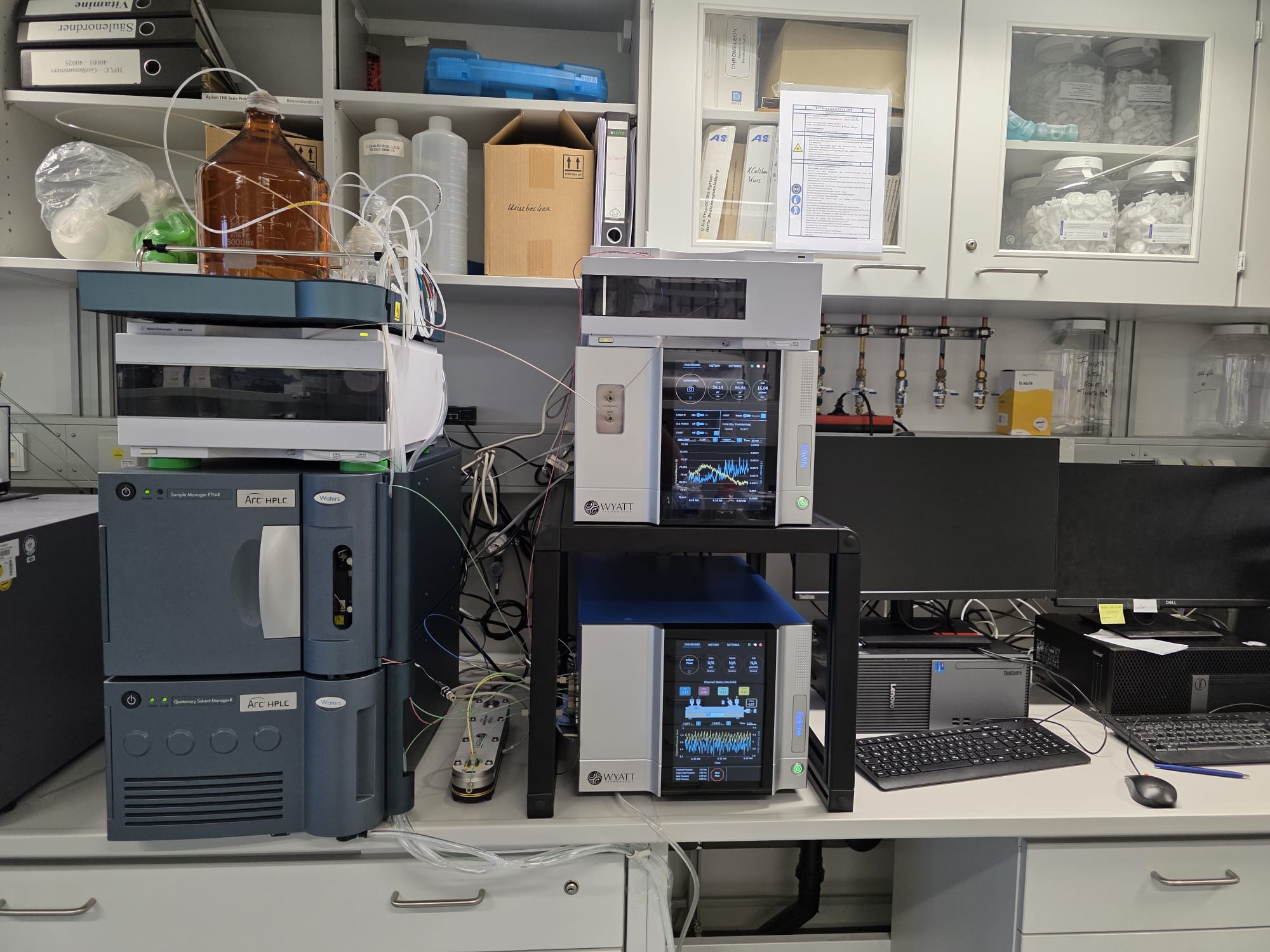
Thanks to the support of the Weihenstephan Association for Brewing, Beverage and Grain Technology (WFBGG e.V.), key components of the AF4 system could be renewed and technically brought up to date. This investment significantly expands the analytical capabilities and lays the foundation for current and future scientific work.
What is AF4 analytics?
Asymmetric Flow Field-Flow Fractionation (AF4) is a gentle, size-based separation method for particles or macromolecules in solution. The sample flows through a thin channel parallel to a semipermeable membrane. A cross-flow draws part of the liquid through the membrane, concentrating the particles toward it. Diffusion counteracts this concentration: smaller particles move back into the channel more strongly, while larger particles remain closer to the membrane. As a result, AF4 separates molecules according to their hydrodynamic size without using a solid stationary phase. Retention time depends on the diffusion constant, channel geometry, and flow rates. In foods and beverages, such as beer, AF4 allows the characterization of proteins, polyphenol complexes, and polysaccharides in an almost unchanged state, as they actually occur in the liquid.
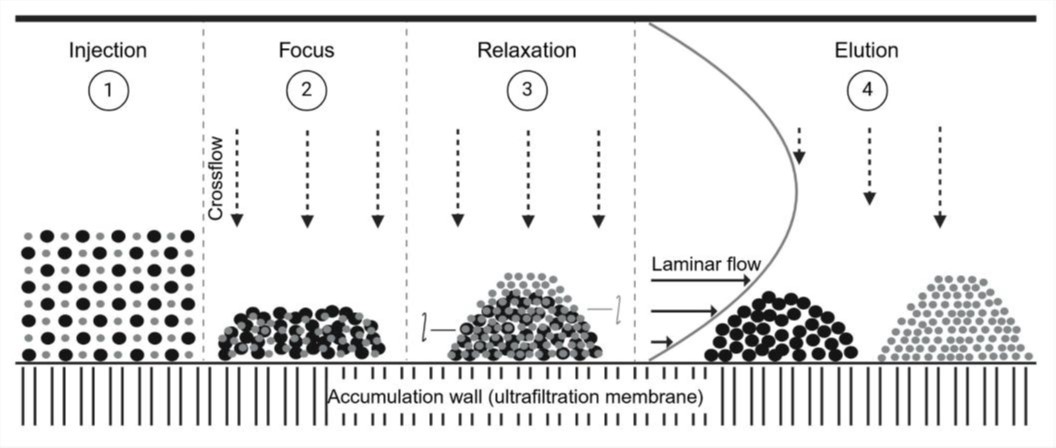
AF4 separation principle according to Moreno Ravelo, R. (2024), Characterization of macromolecular substances in cereal-based beverages using AF4-MALS-DRI (mediaTUM). The sample is injected (1), focused against the membrane by a cross-flow (2), creating a diffusion-dependent concentration distribution (3), and a laminar carrier flow separates the analytes by size, with smaller particles eluting first (4).
Various detectors can be connected to the AF4 separation system to obtain additional information about the eluting molecules. For example, a Multi-Angle Light Scattering (MALS) detector allows the determination of absolute molar mass, while a concentration detector, such as Differential Refractive Index (DRI), measures the molecular concentration. The combination of these detectors enables the direct characterization of proteins, polyphenol complexes, and polysaccharides in beverages and foods without the need for reference substances.
AF4 in current research: Application to beer polysaccharides
Karatairis, Chrysovalantis, Iain Whitehead, Christoph Neugrodda und Thomas Becker (2025): „Limitation of non-starch polysaccharides concentration as a filterability predictor in unfiltered bottom-fermented beers“, LWT – Food Science and Technology, Volume 237. Link zum Paper: https://www.sciencedirect.com/science/article/pii/S0023643825014732
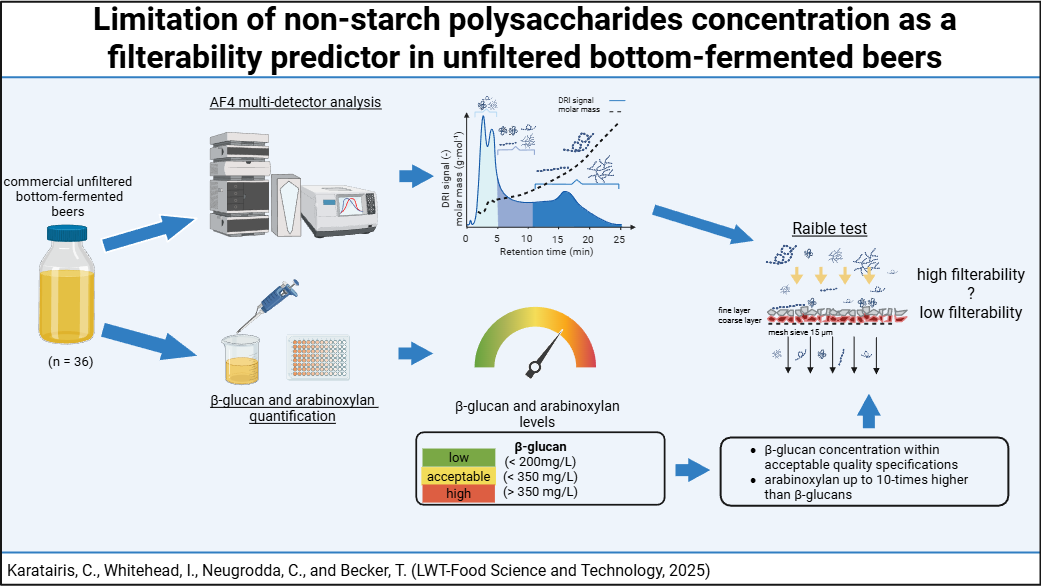
In this study, AF4-MALS-RI-DAD was used to characterize the macromolecular properties (e.g., molar mass, polydispersity) of non-starch polysaccharides (NSPs) in unfiltered, bottom-fermented beers and to investigate their influence on filterability. The results show that NSP concentration alone is not a reliable predictor of filtration performance. Rather, high molar masses, broader distribution widths, and a high proportion of large molecules (>500 × 10³ g/mol) negatively affect filterability, even when common quality criteria (e.g., β-glucan concentration) were met. AF4 analysis provided deeper insights into the macromolecular properties of polysaccharide fractions in their native state within the beer matrix.
Are you interested in AF4 analytics?

If you have questions about the method or the execution of the analyses, please contact:
Dr. Jennifer Schneiderbanger
Laboratory management: Lehrstuhl für Brau- und Getränketechnologie, Technische Universität München
Contact: jennifer.schneiderbanger(at)tum.de
Phone: +49 (0)8161 – 71-3267